
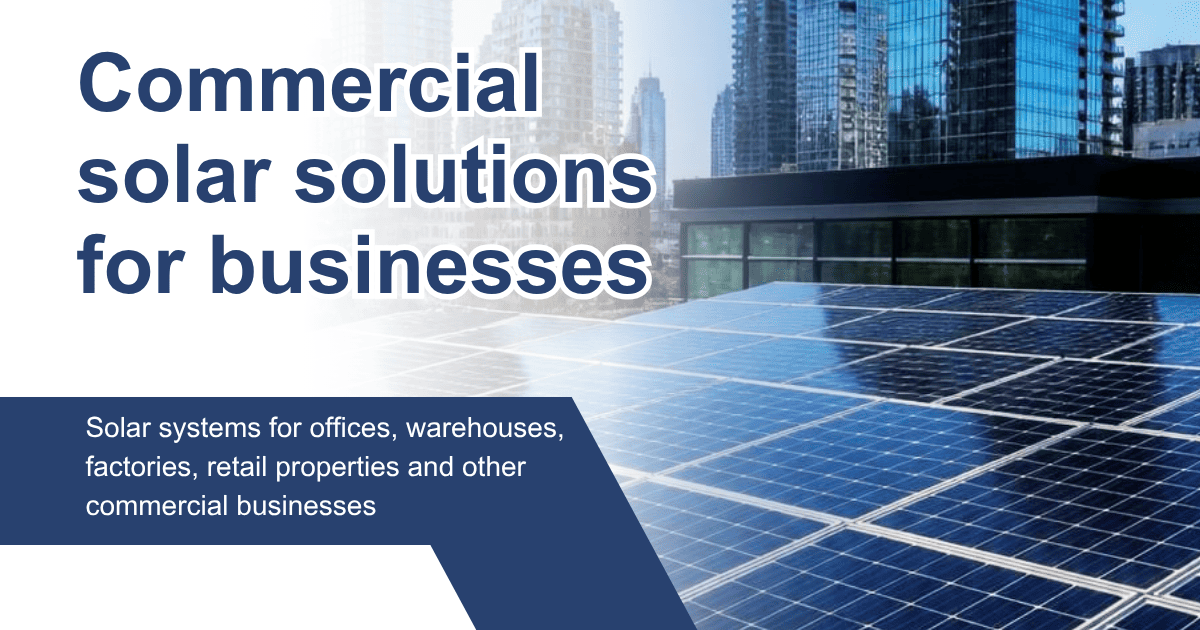
For many businesses across Melbourne and regional Victoria, electricity is an ongoing operating expense. From warehouses and manufacturing facilities to offices, retail stores and medical centres, rising energy costs can put pressure on business margins.
Across Victoria, businesses are considering solar power to generate electricity on-site, reduce reliance on grid electricity, make better use of available roof space
and take control of their energy costs.
Solar can be installed on warehouses, factories, offices, retail premises, schools, medical facilities, farms and other buildings.
Solar systems are designed to meet a business’s energy requirements, including factors such as –
The business’s electricity consumption – The amount of electricity your business uses is an important consideration when determining the appropriate solar system size. Electricity bills and usage data can help identify your current energy requirements.
Daytime and after hours energy usage – Businesses operating during the day can use solar electricity as it is generated, while businesses with higher electricity usage after hours may need to consider battery storage.
Available roof or ground space – The available area for installing solar panels is considered when determining the system size. Roof orientation, panel placement, shading and the condition of the roof are also considered when designing the system.
Existing electrical infrastructure – The existing switchboards, electrical equipment and other infrastructure need to be considered when installing a commercial solar system. Larger systems may require electrical upgrades or additional equipment as part of the solar installation.
Solar generation potential – The amount of electricity a solar system can generate depends on factors such as the property location, roof orientation, tilt, shading and the proposed solar panel system. These factors are considered when estimating the expected solar generation.
Future business expansion – If your business grows in the future, your electricity needs may also increase. New equipment, longer operating hours or building extensions should be considered when choosing the size of your solar system.
Grid connection requirements – Commercial solar systems connected to the electricity grid must meet the requirements of the local electricity distributor. The solar system size, the amount of electricity sent to the grid and the existing electrical setup are considered as part of the connection process.
Eligibility for government incentives – The Australian Government provides incentives for eligible solar PV systems and battery storage through the Small-scale Renewable Energy Scheme (SRES).
Eligible System Sizes
Solar PV – Systems up to 100 kW are currently eligible. From 1 October 2026, subject to regulations, eligible systems above 100 kW and up to 1 MW are planned to be included.
Solar Batteries – Eligible battery systems have a nominal capacity of 5 kWh to 100 kWh, with battery eligibility applying from July 2025.
The amount of financial support depends on the system, installation date and other eligibility requirements.
Commercial Solar and Battery Storage
Solar panels generate electricity during daylight hours, which makes daytime energy consumption important for businesses.
A business can use solar electricity directly while the system is generating power. If the solar system produces more electricity than the business is using at that time, the excess energy may be exported to the grid or, where a suitable battery system is installed, stored for later use.
Battery storage can be relevant for businesses with electricity demand in the evening or outside normal daylight hours.
The suitability of a battery depends on factors such as the business’s electricity consumption, solar generation, battery size and operating requirements.
Government Incentives for Eligible Commercial Solar and Batteries
For eligible small-scale systems, the Small-scale Renewable Energy Scheme (SRES) provides support through Small-scale Technology Certificates (STCs). The Clean Energy Regulator states that eligible solar PV systems currently include systems of up to 100 kW, subject to the applicable requirements.
Changes to Commercial Solar Eligibility From 1 October 2026
From 1 October 2026, eligible mid-scale solar PV systems between 100 kW and 1 MW can also be eligible to create STCs under the expanded SRES arrangements.The Clean Energy Regulator has confirmed that these changes apply to eligible systems installed from 1 October 2026.This change is particularly relevant to larger commercial, industrial and agricultural properties considering solar installations above 100 kW.
Businesses considering a system in this size range should check the current eligibility and compliance requirements before proceeding, as specific requirements apply to mid-scale solar installations.
Solar Battery Incentives
Solar batteries are also eligible for support under the SRES, subject to the applicable requirements.
For eligible battery systems, the Clean Energy Regulator specifies a nominal battery capacity of 5 kWh to 100 kWh. STCs are calculated using usable battery capacity, with STCs available for the first 50 kWh of usable capacity.
Battery incentives have also changed over time. The STC factor is adjusted periodically, so the amount of financial support available can depend on the battery’s installation date and capacity.
Businesses should therefore confirm the current eligibility requirements and available incentive arrangements when planning a battery installation.
Benefits of Commercial Solar for Victorian Businesses
Commercial solar can provide several benefits for businesses, depending on the property and electricity usage.
Generate Electricity On-Site
Solar panels allow businesses to generate their own electricity from sunlight.
The electricity can be used to power the business and help meet its energy needs.
Reduce Grid Electricity Consumption
Using solar power can reduce the amount of electricity a business needs to buy from the grid.
The amount of electricity a business can reduce depends on the size of the solar system and how much electricity the business uses.
Make Use of Commercial Roof Space
Many buildings have large roof areas that can be used for solar panels.
If the roof is suitable, solar panels can use this space to generate electricity for the business.
Reduce Electricity Costs
Using solar power can help reduce the amount of electricity a business needs to buy from the grid.
The amount a business can save depends on factors such as the solar system size, electricity usage and electricity rates.
Business Tax Benefits
Commercial solar may provide tax benefits for some businesses, depending on their circumstances.
Tax benefits can depend on factors such as the business structure, the cost of the solar system and how it is used.
Businesses should talk to their accountant or tax adviser to understand what tax benefits may be available.
Support Renewable Energy Generation
Commercial solar systems use sunlight to generate electricity and can help businesses use more renewable energy.
Choosing a Commercial Solar System
There is no single solar system size that is suitable for every business.
A suitable system should take into account –
Current electricity consumption
Electricity usage throughout the day
Operating hours
Available roof or ground space
Roof condition and orientation
Shading
Existing electrical infrastructure
Expected solar generation
Future electricity requirements
Grid connection requirements
Battery storage requirements
Applicable government incentives
A detailed assessment can help determine the appropriate solar system size and whether battery storage is suitable for the business.
Commercial Solar for Your Business
If your business is considering commercial solar in Melbourne or regional Victoria, the first step is to understand how much electricity your business uses and how that electricity is consumed throughout the day.
From there, the available roof or ground space, electrical infrastructure, solar generation and grid connection requirements can be assessed to develop a system suited to the property.
Looking for a commercial solar solution for your business? Contact our team to discuss your requirements.